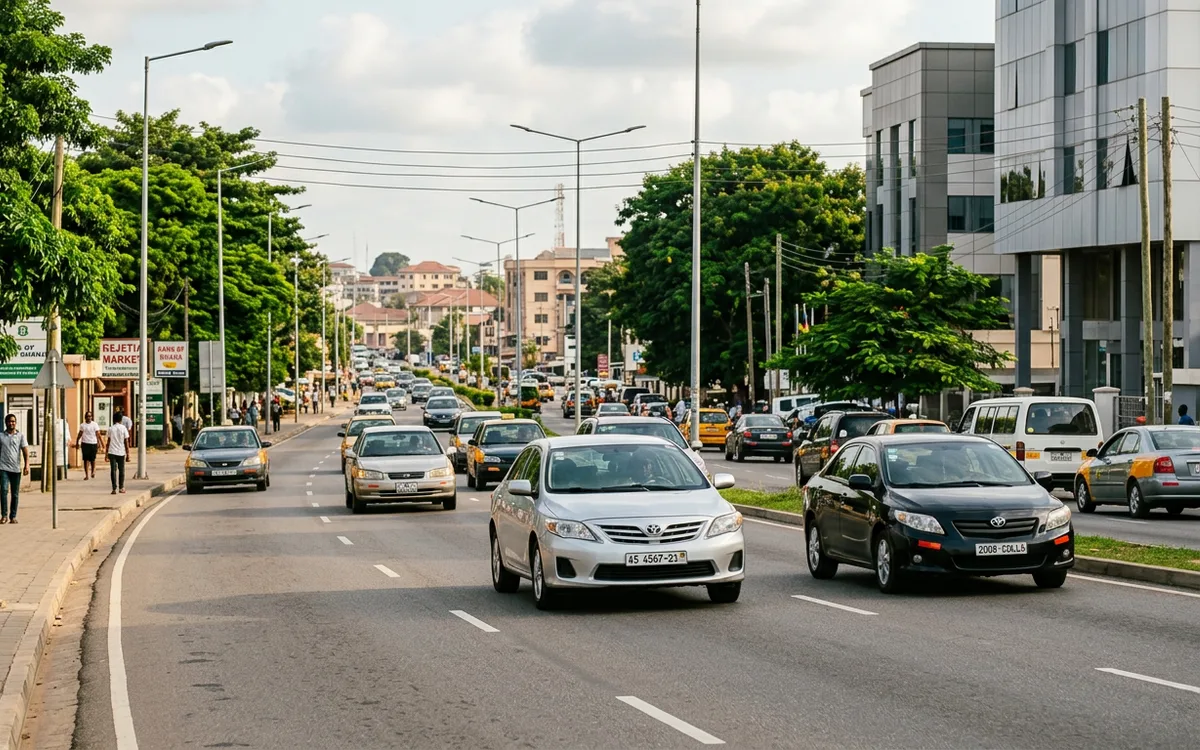
How to Calculate DVLA Registration and Import Duty
Quick answer: To understand how to calculate DVLA registration and import duty in Ghana as of 2026, start with the vehicle's CIF value. Customs applies import duty (5% to 20%), VAT, and statutory levies through ICUMS. Once cleared from Tema or Takoradi ports, DVLA fees range from GHS 450 to GHS 1,900 depending on your engine size.
Importing a home-used Toyota RAV4 or Hyundai Elantra into Ghana requires a clear understanding of government fees at Tema or Takoradi ports. Knowing how to calculate DVLA registration and import duty helps buyers avoid unexpected costs at the port or registration centers in Accra and Kumasi. Customs taxes and licensing fees represent a major portion of your vehicle's total on-road cost, making early financial planning critical.
Navigating the Integrated Customs Management System (ICUMS) and the Driver and Vehicle Licensing Authority (DVLA) can feel overwhelming for first-time importers. As of 2026, duty rates depend heavily on vehicle age, body style, and engine displacement. This complete guide provides exact formulas, fee tables, and practical tips to accurately estimate total expenses before your shipment arrives at the port.
Key Takeaways
- Import duty rates range from 5% to 20% based on vehicle type and commercial classification.
- CIF value combines Free on Board purchase price, ocean freight, and transit insurance.
- GRA applies statutory levies including VAT, NHIL, GETFund, and the ECOWAS import levy.
- DVLA registration fees range between GHS 450 and GHS 1,900 based on engine displacement.
- Over-age penalties apply to passenger vehicles manufactured more than ten years prior to import.
Understanding Ghana Customs CIF Valuation and Import Taxes
Before calculating any duties, Ghana Revenue Authority (GRA) Customs Division establishes the Cost, Insurance, and Freight (CIF) value of the vehicle. Customs uses standardized price databases in ICUMS rather than relying solely on your purchase invoice. If you buy a foreign-used Honda CR-V in North America for $6,000, ICUMS assesses shipping costs to Tema alongside insurance to determine the official CIF dollar benchmark.
Once ICUMS determines the CIF amount, GRA converts it into Ghana Cedi using the current prevailing exchange rate. This Cedi value forms the baseline for applying import duty, which varies from 5% for commercial trucks to 20% for standard passenger cars. SUV models and luxury sedans face the standard 20% rate, making accurate initial assessment essential before your container arrives at the harbor.
Below is an overview of standard GRA import duty rates applied to common vehicle categories in 2026.
| Vehicle Category | Import Duty Rate | Typical Models | Estimated Duty on GHS 100,000 CIF |
|---|---|---|---|
| Saloon / Passenger Cars | 20% | Toyota Corolla, Honda Civic | GHS 20,000 |
| SUVs and Cross-overs | 20% | Toyota RAV4, Hyundai Tucson | GHS 20,000 |
| Buses / Commercial Vans | 10% | Toyota HiAce, Nissan Urvan | GHS 10,000 |
| Heavy Cargo / Trucks | 5% | Kia Rhino, DAF Trucks | GHS 5,000 |
How to Calculate DVLA Registration and Import Duty Step by Step
Calculating total clearance and licensing costs requires following a clear sequence of mathematical steps. Every charge builds on previous sub-totals, starting from basic customs duty down to local clearing agent fees. Missing one component like the ECOWAS levy or environmental tax can severely alter your final budget before bringing the vehicle onto Ghanaian roads.
Ghana Customs uses integrated digital systems to apply these taxes automatically, but calculating them manually allows buyers to prepare financially. By breaking down the formula into distinct stages, importers in Accra and Kumasi can verify clearing agents' quotes and budget accurately. The following step-by-step procedure walks you through the calculation from port arrival to license plate issuance.
Follow these sequential steps to estimate your total clearance duty and registration cost in Ghana.
- Determine the vehicle CIF value in GHS by converting the foreign purchase, freight, and insurance costs using the current GRA exchange rate.
- Calculate basic import duty by multiplying the GHS CIF value by the applicable rate (20% for passenger cars, 10% for commercial buses).
- Add statutory levies including NHIL (2.5%), GETFund (2.5%), VAT (15%), and the 0.5% ECOWAS trade levy to the baseline total.
- Calculate specific fees such as the Environmental Excise Tax and Special Import Levy based on engine capacity and vehicle age.
- Sum all customs duties, taxes, port handling fees, and clearing agent fees to establish total port clearance cost.
- Calculate DVLA registration charges based on engine capacity (cc) plus physical plate stamping and documentation fees.
GRA Customs Levies, Statutory Fees, and Age Adjustments
Beyond the basic 20% import duty, GRA levies several statutory taxes that significantly increase total clearance expenditure. These charges include the National Health Insurance Levy (NHIL), Ghana Education Trust Fund (GETFund), Value Added Tax (VAT), and the COVID-19 Health Recovery Levy where applicable. Combined statutory taxes usually add an extra 25% to 35% on top of the base CIF value.
Vehicle age plays a critical role in final customs calculations at Tema Port. Under Ghanaian customs laws, vehicles older than ten years attract an over-age penalty fee. This levy discourages the importation of older, higher-emitting vehicles that contribute to pollution and frequent breakdowns on traffic-heavy corridors like Spintex Road and the N1 highway.
Breaking Down Statutory Taxes and Penalties
Importers must account for the Environmental Excise Tax, which scales higher for vehicles with larger engine capacities exceeding 2.0 liters. For instance, a 3.5-liter V6 engine pays a considerably higher environmental tax compared to an economical 1.5-liter hatchback. Additionally, vintage or heavily damaged salvage vehicles face higher inspection charges during physical customs examination.
- Over-age penalty applies to passenger vehicles manufactured more than 10 years prior to importation.
- Environmental Tax ranges from GHS 100 to GHS 1,500 depending on engine capacity (cc).
- Import VAT of 15% applies to the sum of CIF value plus basic import duty.
- ECOWAS Trade Levy adds 0.5% to finance regional community development programs.
- EXIM Levy adds 0.75% to support national export promotion initiatives.
Breaking Down DVLA Registration Fees by Engine Capacity
After clearing your vehicle from customs, the next mandatory expense is vehicle registration through the Driver and Vehicle Licensing Authority (DVLA). Registration fees are non-negotiable and are calculated primarily based on engine displacement (measured in cubic centimeters or cc). Whether registering at 37 Military Hospital DVLA in Accra or the Kumasi station, fee structures remain uniform across Ghana.
DVLA categorizes personal vehicles into distinct engine capacity brackets ranging from under 1.6 liters up to over 3.0 liters. Smaller engines like a 1.2-liter Nissan Note pay lower registration charges, making them budget-friendly for daily city commuting. Larger engines found in luxury SUVs or heavy-duty pickup trucks pay substantially higher registration fees annually.
2026 DVLA Vehicle Registration Cost Brackets
As of 2026, registering a standard saloon car with an engine under 2.0 liters costs approximately GHS 450 to GHS 750, inclusive of physical license plates and vehicle logbook issuance. Vehicles with engines between 2.0 and 3.0 liters attract registration fees between GHS 850 and GHS 1,300. High-displacement engines exceeding 3.0 liters incur fees up to GHS 1,900.
In addition to engine-based fees, vehicle owners must factor in mandatory ancillary costs during registration. These include charges for physical license plates, reflector stickers, vehicle inspection tests, and administrative processing fees. First-time registration also requires proof of valid motor insurance, which varies based on comprehensive or third-party coverage selection.
Common Pitfalls and Hidden Costs in Car Clearance
Many car buyers in Ghana underestimate total acquisition costs because they focus solely on purchase price and basic import duty. Hidden charges at Tema Port can quickly disrupt your financial plan if left unconsidered. Demurrage charges represent one of the most common surprise costs, accruing daily when containers sit at the port beyond allotted free storage days.
Exchange rate fluctuations present another major risk during clearance operations. Because GRA Customs calculates duty using weekly updated interbank exchange rates, a sudden depreciation of the Cedi against the US Dollar can increase your total duty by thousands of Cedis overnight. Working with experienced, licensed clearing agents helps avoid unnecessary delays that trigger extra fees.
- Demurrage charges accumulate when cargo clearance exceeds free port storage limits.
- Exchange rate volatility can suddenly inflate GHS duty totals prior to final payment clearance.
- Shipping line administrative fees and terminal handling charges (THC) must be paid separately.
- Physical inspection fees apply if Customs flags a vehicle for detailed examination.
- Unauthorized agent fees can increase total cost if clear written quotes are not established early.
Final Costs: Port Handling, Clearing Agent Fees, and Licensing
The overall cost of placing an imported vehicle on Ghanaian roads extends past official government taxes and DVLA fees. Terminal handling charges paid to port operators like Meridian Port Services (MPS) in Tema cover container offloading, storage, and yard movement. These charges are fixed by terminal operators and are independent of GRA customs duties.
Hiring a reliable, licensed customs clearing agent is essential for navigating ICUMS documentation without expensive errors. Clearing agent service fees typically range from GHS 1,500 to GHS 3,500 depending on clearance complexity and turnaround speed. Ensuring your agent provides itemized receipts protects you from inflated operational claims during the clearance process.
Preparing Your Complete Vehicle Acquisition Budget
To budget accurately for an imported foreign-used car, allocate roughly 40% to 65% of the vehicle's purchase price toward shipping, import duty, port charges, clearing fees, and DVLA registration. For example, a car bought for GHS 100,000 overseas may require an additional GHS 50,000 to GHS 65,000 to fully clear customs, register with DVLA, and drive legally on Ghanaian roads.
Maintaining a cash reserve of 10% above your calculated total provides a crucial safety net for unexpected shipping delays or temporary tariff adjustments. Once registered, budget for immediate routine servicing—such as oil changes and suspension checks—to handle Ghana's demanding road conditions, from dusty suburban streets to potholed bypass routes.
Frequently Asked Questions
Below are clear answers to common questions Ghanaian car buyers ask when calculating customs duties and DVLA registration fees.
How is import duty calculated on cars imported into Ghana?
Import duty is calculated by applying a percentage (usually 20% for passenger cars) to the vehicle's CIF (Cost, Insurance, and Freight) value in Ghana Cedi. GRA Customs calculates CIF using ICUMS valuation databases, adding statutory taxes like VAT, NHIL, GETFund, and environmental levies to compute total customs duty.
How much does DVLA registration cost in Ghana as of 2026?
As of 2026, DVLA registration costs range from GHS 450 to GHS 1,900 depending on engine capacity. Engines under 2.0 liters pay lower rates around GHS 450-750, while vehicles with engines exceeding 3.0 liters pay higher fees. License plates, inspection, and logbook fees are included in total cost.
What is an over-age penalty on imported vehicles in Ghana?
An over-age penalty is a financial charge imposed by GRA Customs on passenger vehicles imported into Ghana that are older than ten years from their manufacture date. The penalty increases with vehicle age to discourage older imports that contribute to environmental pollution and frequent road breakdowns.
Can I calculate my import duty before buying a car overseas?
Yes, you can estimate your duty using the vehicle's estimated CIF value and GRA duty rates. By converting purchase price, shipping costs, and insurance to Cedis and applying the 20% duty rate plus statutory taxes, you can calculate total clearance costs prior to shipping your vehicle.
What documents are required for DVLA car registration in Ghana?
DVLA registration requires the original Bill of Lading, Customs assessment and release receipts, vehicle allocation sheet, valid national ID (Ghana Card), motor insurance certificate, and physical vehicle inspection report. Having these documents ready ensures smooth processing at any regional DVLA center in Ghana.
Final Advice for Ghanaian Car Buyers
Calculating DVLA registration and import duty accurately is the key to a stress-free car buying experience in Ghana. By understanding how GRA establishes CIF values, applying statutory taxes, and accounting for DVLA engine-capacity brackets, you can plan your budget with confidence before purchasing a vehicle abroad or at local ports.
Always work with certified clearing agents and verify all ICUMS payment assessments directly through official GRA channels. Proper financial planning ensures your foreign-used vehicle moves smoothly from Tema or Takoradi ports to DVLA registration, getting you onto Ghana's roads safely without unexpected financial surprises.

CarChale
FounderSure there isn't anything embarrassing hden in the middle of text. All repeat predefined chunks as the as necessliary, making this the first 200 our asliatin words, combined with a handful.<p><a href="https://kasgraph.com/">kasgraph.com</a></p>
0 Comments
Drop your comment
Popular Blog
27 Oct, 2026
27 Oct, 2026